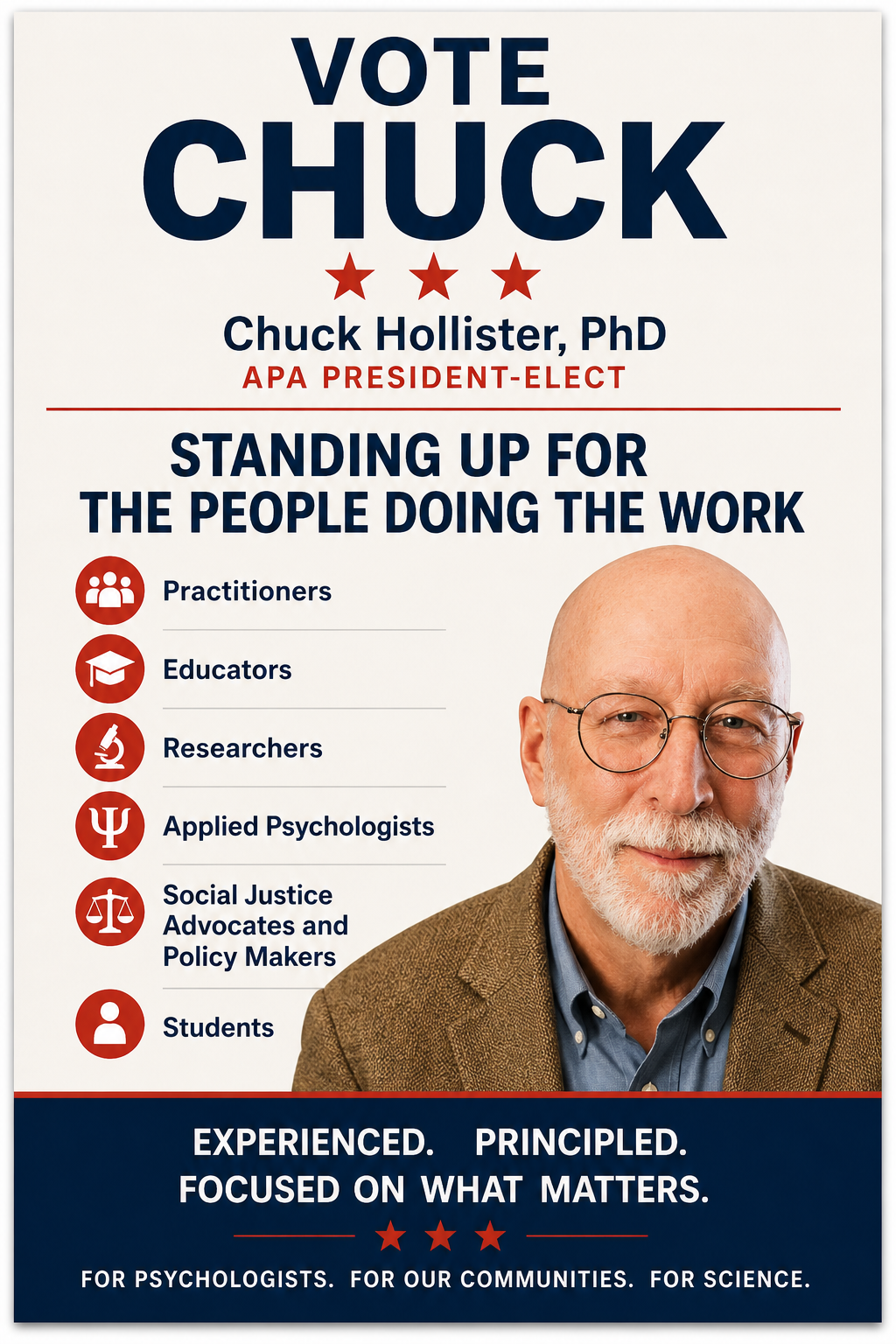
For psychologists across practice, education, consulting, administration, and training,
It’s time to focus on the day-to-day needs of working psychologists.
Hi, I’m Chuck Hollister and I am running for APA President-Elect.
Supported by psychologists
Chuck is honored to be endorsed by the following groups:
Division 31 - State, Provincial, and Territorial Psychological Associations Affairs
Division 55 - Society for Prescribing Psychology
Division 42 - Psychologists in Independent Practice
Division 38 - Society for Health Psychology
Council of Representatives - Association of Practicing Psychologists
Council of Representatives - Caucus of State, Provincial, and Territorial Representatives
Council of Representatives - Rural Health Caucus
Council of Representatives - Caucus of Men and Boys
Association of Jewish Psychologists (with Margaret Kovera)
National Psychology Training Consortium
Missouri Psychological Association
Rhode Island Psychological Association
“Whoever you vote for make sure that they are a person of service who is dedicated to strengthening our professions and science for the benefit of all of us.”
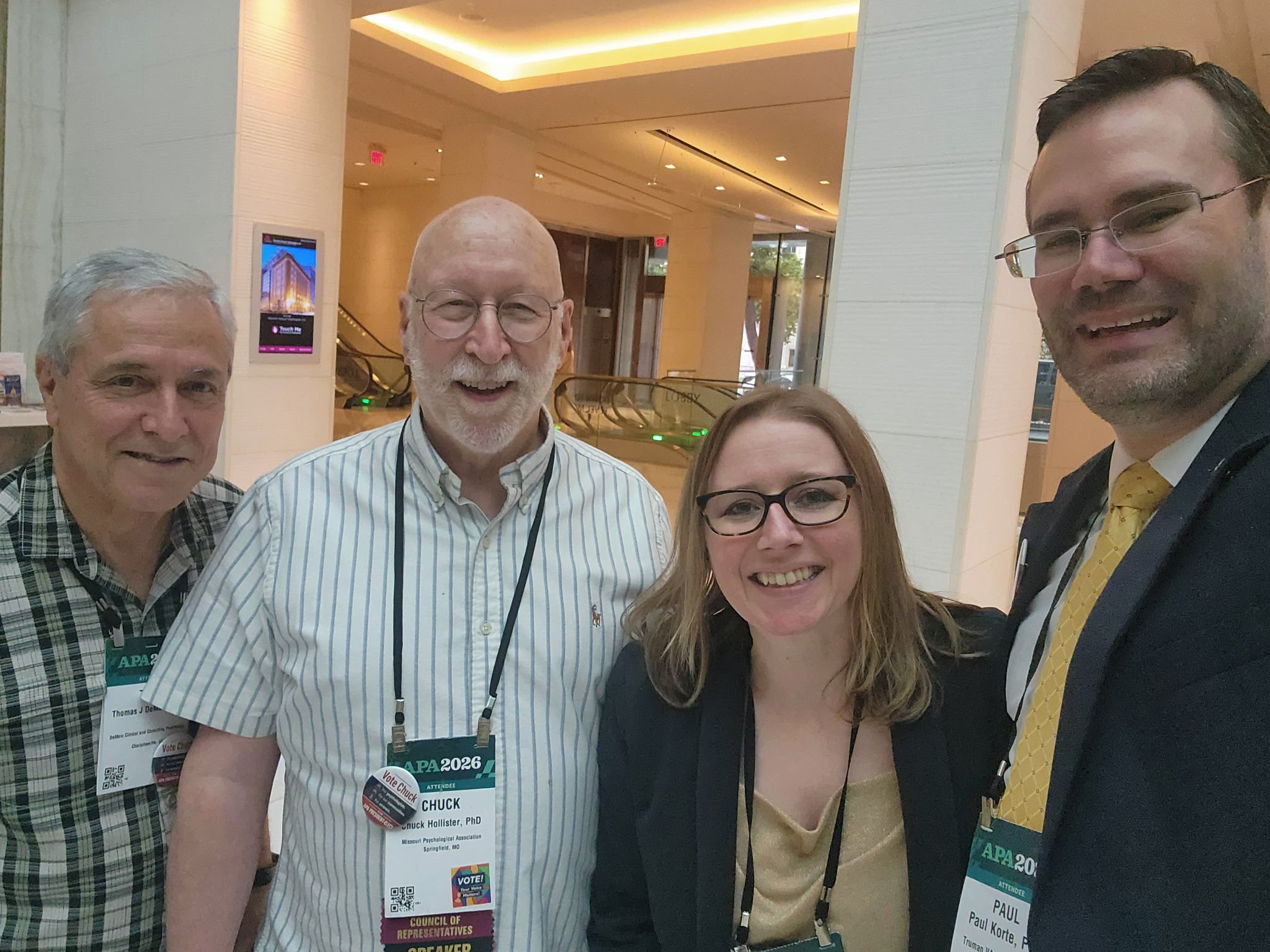
Leadership Measured in Results
Chuck has spent his career turning psychologists’ concerns into practical results—organizing people, building coalitions, and moving ideas into action.
Helped shape APA’s direction and advocacy
Chuck was selected to serve on APA’s Strategic Plan Update Advisory Committee, where he emphasized the importance of psychologists, Divisions, and SPTAs. He helping shape the association’s long-term direction and priorities. He was appointed to APA’s Advocacy Coordinating Committee and contributed to the development and advancement of psychology’s federal advocacy agenda. He helped APA develop demographics that helped APA understand what members really wanted from their organization.
Strengthened the organizations that support psychologists
Chuck was a central advocate for APA’s first increases in SPTA operational and legislative grants in 17 years. He also helped establish national continuing-education workshops that generate revenue for SPTAs and worked with the National Register to create annual cash awards supporting state advocacy. He believes strongly in recognizing the Divisions for their subject expertise.
Advanced practice and reimbursement
In Missouri, Chuck helped secure commercial parity for audio-only telehealth, Medicaid reimbursement parity with psychiatry for comparable services, Medicaid billing by psychology interns, coverage for Health Behavior Assessment and Intervention services, and passage of PSYPACT.
Built coalitions across psychology
Chuck and Mayra Zoe Ortiz brought together representatives from more than 40 SPTAs to share successful approaches to social justice advocacy. He has repeatedly connected state associations, divisions, caucuses, and other psychology organizations around shared goals.
Protected the people doing the work
Chuck wrote and helped pass an APA Council measure providing greater protection for members facing doxxing. His advocacy consistently focuses on the psychologists, educators, researchers, consultants, students, and association leaders whose daily work sustains our profession.
A Record Recognized Across Psychology
Chuck is a three-time APA Fellow and Division 31 2025 Psychologist of the Year whose campaign has earned support from organizations representing independent practice, health psychology, prescribing psychology, SPTAs, rural health, training, and other constituencies across APA.
Chuck doesn’t simply identify problems. He brings people together and gets results.
What we need to do is clear!
We must fight for reimbursement increases.
1/3 of psychologists no longer take insurance. Why? Stagnant and shrinking reimbursement. Addressing this must be a priority.
We must advocate for research funding, academic freedom, and job security for researchers and educators.
Science and our academic institutions are under attack. We must stand up for them and for our educators and researchers.
We need to breakup the student debt trap and open up Medicare to interns.
We need to search for innovative ways to reduce student debt and to keep students from accumulating more. Our students should be able to bill Medicare during their internships like physicians.
Let’s secure the time-free CPT codes that make physicians more efficient and that allow them to be reimbursed for the supervision they provide.
Psychologists need access to the same time-free E/M codes that reward physicians for the complexity, risk management, and responsibility they have for medical decision-making. We should also have access to the Incident To codes that allow reimbursement for the supervision we provide.
We need to lead with our science.
What is most unique about psychology? It’s science. We need to make it more visible, actively make it available, not just to the public, but within our professional ranks. Our members should have up-to-date access to our most cutting edge research. That means promoting the researchers and educators that make this possible.
Evolve the doctorate to include more market-relevant education in RxP, tech, business, administration, and law.
Professions evolve. Think nursing and the rise of nurse practitioners. Psychology impacts so many professions. Our students need the opportunity to access market-relevant, cross-disciplinary education in RxP, business, tech/computers, administration, and law, so that they can succeed in our current economy. Psychologists are often seen as having great potential as leaders. Let’s provide education in that. — all without increasing a student’s time in school.
We must keep our social justice commitments and find ways to communicate them that succeeds across our country’s many divides.
We know that our language can be weaponized and has. APA must help psychologists communicate these values in ways that reach more people, protect vulnerable communities, and succeed across different states and political realities.
The value of psychologists must be made unmistakable to the public, insurers, and employers.
This should be one of the primary tasks of an association supportive of psychologists. We need to show the value of psychologists, not just psychology.
We must unambiguously clarify the difference between a doctoral and master’s degree in psychology, social work, and counseling.
Psychologists need to be recognized for their superior skills in diagnosis, assessment, and the management of clinical and medical complexity. We are trained to look beneath symptoms, understand context, evaluate risk, integrate data, and distinguish between overlapping psychological, medical, developmental, cognitive, and social factors. That depth matters when patients present with trauma, chronic illness, substance use, suicidality, neurodevelopmental concerns, cognitive impairment, family stress, pain, disability, or complex comorbid conditions.
If we can’t clarify the difference between a master’s and doctoral degree, we shouldn’t expect insurance companies, employers, and the public to be able to.
Let’s help consulting psychologists compete more effectively.
Consulting psychologists bring psychological science into leadership, organizations, workplaces, courts, health systems, public agencies, and communities. But too often, they compete in markets that do not understand what makes psychological expertise different from coaching, HR consulting, or general management advice.
APA should help consulting psychologists define and market their value more clearly.
Let’s rebuild a sense of shared purpose across psychology’s varied professions.
Divisiveness is everywhere in our society. We are a relatively small profession. We can’t afford it. We need to watch each others’ backs like we see in medicine.
We must nurture our communities — the SPTAs and Divisions and support their financial well-being.
Our communities are our lifeblood. They need to be strong and represent the interests of members.